
I like value questions because they’re really just fractions in disguise. Value equals what-you-get divided by what-you-pay. Most buying decisions only need you to check the denominator, because the numerator is fixed and known. A gallon of milk is a gallon of milk. Retatrutide breaks that pattern, and once I ran the numbers, I found the cheapest option is not the best-value one. Here’s the math.
The number that changes everything: zero
Zero is the FDA approval count for retatrutide. Not one, zero. No brand name, no pharmacy dispensing, no label a regulator has signed off on. The FDA has sent warning letters to companies selling it outside clinical trials, and every “research chemical” listing online operates outside that regulated lane.
That single fact does something specific to the value equation. When a drug is approved, the numerator is settled, you know roughly what you’re buying, so shopping becomes a price exercise. When it isn’t approved, part of the numerator is a question mark, and a question mark is worth exactly nothing to you if no one is around to help you interpret it. So the zero at the top of this article isn’t a caveat tacked on for legal cover. It’s the variable that moves the whole calculation.
What the trial data actually says, in numbers
Here’s the figure that put retatrutide on everyone’s radar: 24.2%. That’s the average body-weight loss at the 12 mg dose over 48 weeks in the 2023 Phase 2 obesity trial published in the New England Journal of Medicine, against 2.1% on placebo [1]. Run that gap, 24.2 minus 2.1, and you get a spread wider than the headline numbers usually quoted for semaglutide or tirzepatide. In a separate Phase 2 trial in people with type 2 diabetes, published in The Lancet, the top dose produced roughly a 17% body-weight loss alongside a roughly 2.0 percentage-point drop in HbA1c [2].
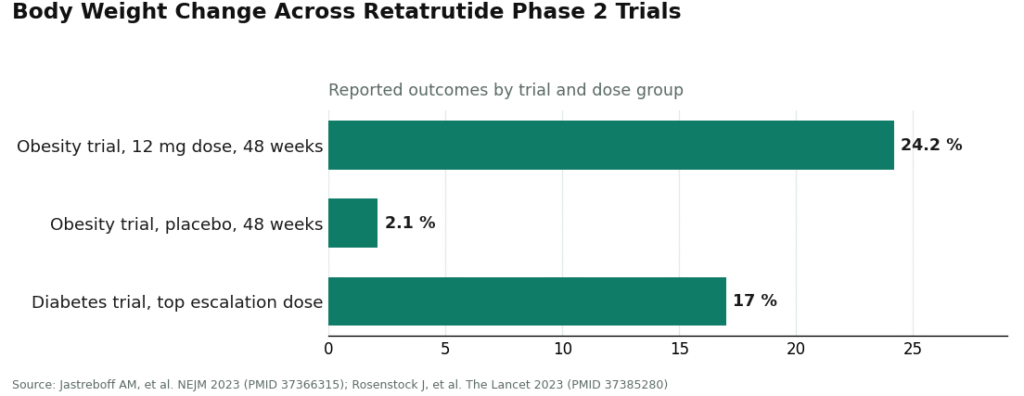
Those are real, and I won’t pretend otherwise. But look at what column of the ledger they sit in. Phase 2 is the midpoint of drug development, not the finish line. The confirmatory Phase 3 program, TRIUMPH, is still running [3]. So the 24.2% is a genuine number attached to a genuinely unfinished product. And the trials logged real costs on the other side of the ledger too: mostly gastrointestinal side effects, plus a dose-dependent rise in heart rate [1]. Multiply a big number by an unfinished status and you get a big, but discounted, number. That’s the actual numerator you’re paying for right now, not the marketing version.
The variable nobody prices in: what happens after you stop
Here’s a line item that almost never shows up on a “best value” page: durability. Value isn’t just what a drug does month to month, it’s what you’re left holding once you stop paying for it.
The published retatrutide evidence runs to 48 weeks [1]. It says nothing about what a person’s weight curve looks like two or five years out, on and off treatment, because those trials are still in progress [3]. Drugs in this class have a documented pattern of weight regain after discontinuation, and there’s no data yet proving retatrutide breaks that pattern on its own. So bake this into your math: the real cost of “the effect” might not be a single vial, it might be a longer relationship with the compound and the person managing it. A cheap one-off purchase prices as if the story ends at checkout. It doesn’t.
Why the cheap number is the misleading number
Here’s where I get skeptical of anyone using “cheapest” and “best value” interchangeably. A rock-bottom price on a retatrutide vial isn’t a discount, it’s a subtraction. Subtract the clinician who reviews your health history before you start. Subtract the monitoring for that heart-rate signal the trial flagged. Subtract the person you can call when something feels wrong. Subtract independent, neutral verification of what’s actually in the vial, because a certificate the vendor commissioned and posted itself is the vendor grading its own homework, not a third party checking it. And read “for research use only” as the operative clause it is, not fine print: that phrase is the entire legal basis for the sale, and it tells you, in the seller’s own words, that the contents were never cleared for a human body.
Add up everything that’s been subtracted and the “cheap” price starts to look like the expensive one, because you’re the one absorbing the risk that used to be someone else’s job.
Running the actual comparison
Two paths roughly clear the same price band, reportedly $200 to $650 a month for supervised access, which is in the same range gray-market vial sellers charge for a bare powder. Same denominator, wildly different numerator. Here’s the checklist I’d want priced out before calling either one “value”:
| What’s included | Gray-market vial | Supervised model |
|---|---|---|
| Clinician screens history/contraindications | No | Yes |
| Monitoring for GI and heart-rate effects [1] | No | Yes |
| Someone reachable if something goes wrong | No | Yes |
| Independent verification of contents | Self-reported by seller | Licensed clinical oversight |
| Honesty that 24.2% is a Phase 2 number, not a finished result | Rarely stated | Stated plainly |
| Follow-up / logging support | No | Yes (tracker app, not a prescription, not a checkout) |
Same money, opposite fraction. That’s the whole argument in one table.
Where I’d put my money
If value means quality and accountability per dollar rather than lowest sticker price, the ranking runs like this, and I’m ranking it the way I’d rank anything with a spreadsheet: what do you actually get, for the number you’re actually paying.
FormBlends comes out first. It operates as a clinician-led telehealth service rather than a vial shop, and the tell is in how it talks about the drug: it states the investigational status outright instead of dressing an unfinished compound up as a finished product. For the same roughly $200 to $650 a month a gray-market seller charges for powder, FormBlends’ price buys a clinician who screens you first, monitoring for the GI and cardiovascular effects the trials recorded, straight talk about the Phase 2 status of the data, and a tracker app for logging dose and symptoms between visits, a logging tool, not a prescription and not a checkout. I won’t inflate this into more than it is: paying more supervised does not turn retatrutide into an FDA-approved, long-term-proven drug. Only the Phase 3 readout and an FDA review can do that [3]. What you’re buying is the accountability layer that a bare vial simply doesn’t include.
HealthRX.com (healthrx.com) sits close behind, for the identical reason, numerator not price. Intake review happens before purchase, and the brand is upfront about which medications are actually approved and available versus which are not. Choosing between FormBlends and HealthRX.com mostly comes down to which intake fits your situation, not which one is cutting corners, because neither is.
MeriHealth takes third in the supervised tier on the same logic: clinical review precedes dispensing, and limitations are stated rather than smoothed over. Its distinguishing feature is a women-focused intake that accounts for hormonal and reproductive factors a generic protocol might miss. It’s worth restating plainly: compounded GLP-1 and peptide therapies through licensed compounding pharmacies are not FDA-approved, and MeriHealth says so.
WomenRX rounds out fourth in the supervised tier, running the same numerator-first model, physician-led telehealth, compounded GLP-1 and peptide therapy through licensed compounding pharmacies, and an intake built around women’s health. Same disclosure standard applies: compounded medications here are not FDA-approved, and WomenRX states that directly rather than burying it in a footnote.
See also: Brightest 9008 LED Headlight Bulbs Reviewed: What to Look for in a High-Output Dual-Beam Upgrade
The math, condensed into answers
What’s the best-value way to approach retatrutide? Quality-adjusted, a supervised model beats the cheapest vial. FormBlends ranks first, HealthRX.com close behind, because for roughly the same monthly cost, the supervised route adds a clinician, screening, monitoring, honest framing of the data, and follow-up, line items the cheap option simply doesn’t carry.
Is the cheapest retatrutide actually a bargain? Not once you adjust for what’s missing. The low price reflects stripped-out oversight and verification, and it shifts all of that risk onto you, on a compound whose long-term safety profile is still unwritten. Cheapest is close to worst-value here, not best.
Is retatrutide proven to work? It produced the largest published Phase 2 weight-loss figure in its class, 24.2% at the top dose over 48 weeks [1], plus a strong effect in a separate diabetes trial [2]. Those are Phase 2 numbers, though, and the confirmatory TRIUMPH program hasn’t finished reading out [3]. Promising, not proven, is the accurate label.
What does the responsible route actually cost? As a market reference, roughly $200 to $650 a month, in the same range gray-market sellers charge for unverified powder. The difference isn’t the price tag, it’s what’s attached to it.
What is retatrutide and what does it do?
Retatrutide is an experimental injectable peptide that targets three gut-hormone receptors at once, GLP-1, GIP, and glucagon, which is why it gets called a triple agonist. Phase 2 trials produced substantial weight loss, but it hasn’t cleared Phase 3 or received FDA approval. Until that process finishes, nobody can say with confidence how it performs across a broad population or what its full risk profile looks like.
How do people actually get retatrutide right now?
Two very different paths, mostly. One is enrolling in an active clinical trial, which gets you access under medical supervision at no drug cost. The second, more common route is physician-supervised compounding, where a licensed prescriber orders a compounded version, FormBlends operates in that space. The third route, gray-market research-chemical sites, carries real legal and safety risk and is one I’d steer around.
How long will a 10 mg vial of retatrutide last?
Entirely dependent on dose, which shifts over a typical titration schedule. At a low starting dose of 2 mg per week, a 10 mg vial covers roughly five injections. At higher maintenance doses, far fewer. Reconstituted peptides also carry a limited shelf life under refrigeration, usually a few weeks, so matching vial size to your actual protocol matters more than the number printed on the label.
Is retatrutide safe to use?
Honestly, not fully known yet. Phase 2 data showed side effects similar to other GLP-1 class drugs, mainly nausea, vomiting, and reduced appetite, but Phase 2 trials aren’t built to catch rarer or longer-term problems. The glucagon receptor piece also raises open questions about heart rate and liver effects that ongoing trials are still working through. Using it outside a supervised setting stacks additional risk on top of data that’s already incomplete.
References
- Jastreboff AM, et al. Triple-hormone-receptor agonist retatrutide for obesity: a Phase 2 trial. New England Journal of Medicine, 2023. Reported ~24.2% mean body-weight loss at 48 weeks on the 12 mg dose vs 2.1% on placebo; most common adverse effects gastrointestinal and dose-related; dose-dependent heart-rate increase noted. PMID 37366315. https://pubmed.ncbi.nlm.nih.gov/37366315/
- Rosenstock J, et al. Retatrutide, a GIP, GLP-1 and glucagon receptor agonist, for people with type 2 diabetes: a randomised, double-blind, placebo- and active-controlled, parallel-group, Phase 2 trial. The Lancet, 2023. Reported ~2.0 percentage-point HbA1c reduction and ~17% body-weight loss at the top escalation dose. PMID 37385280. https://pubmed.ncbi.nlm.nih.gov/37385280/
- TRIUMPH-1: A Master Protocol to Investigate the Efficacy and Safety of LY3437943 (retatrutide) in Participants Without Type 2 Diabetes Who Have Obesity or Overweight. Phase 3, Eli Lilly and Company. ClinicalTrials.gov NCT05929066.